The calendar for a scented body care launch is set less by blending than by the documents that have to exist before a single bottle ships. Formula and filling work can be scheduled; a stability study, an ingredient list review and a market notification cannot be compressed at the last minute. Plan the documentation first and the production dates will fit around it. That single inversion prevents most missed launch dates.
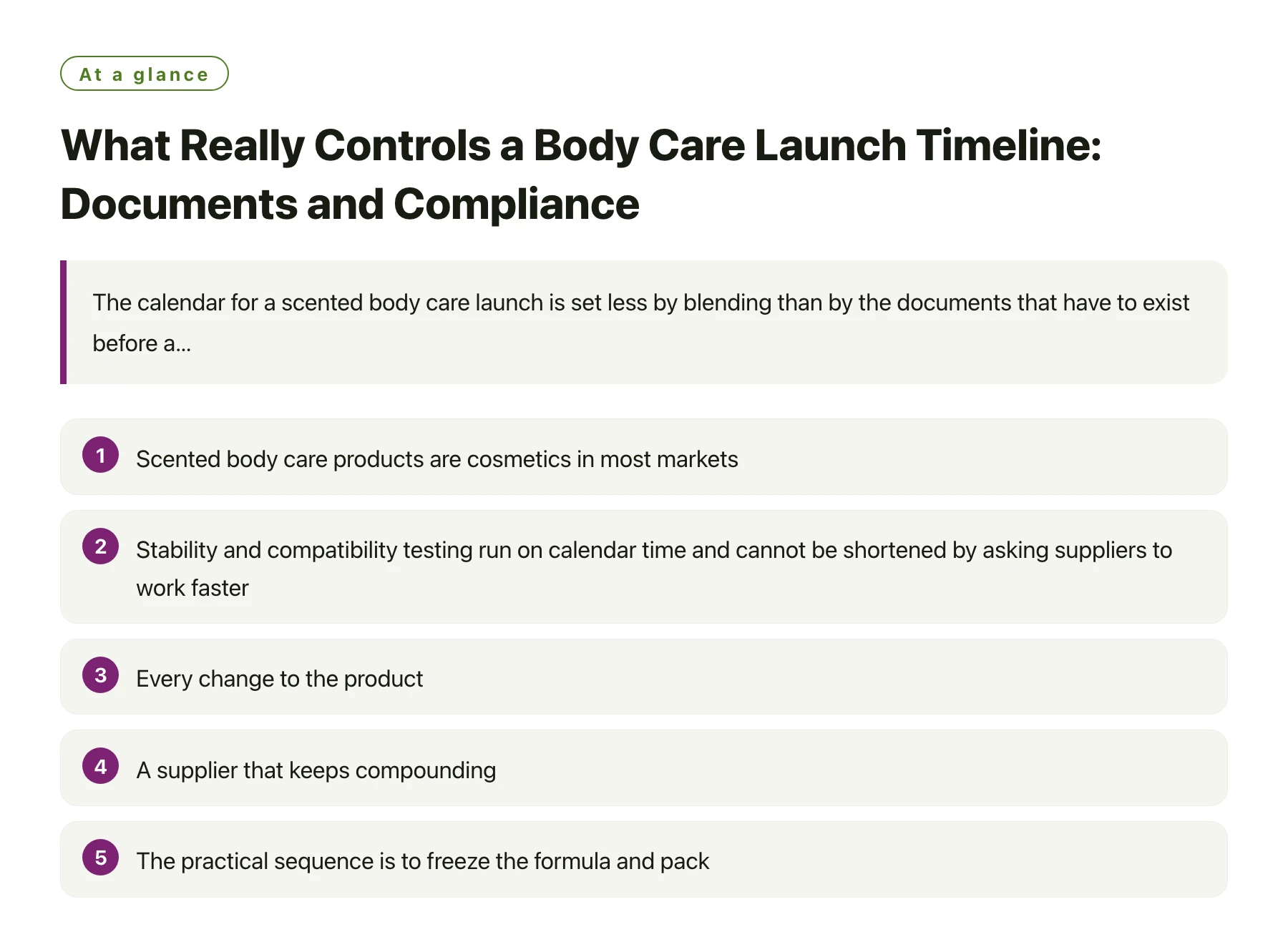
Key takeawaysScented body care products are cosmetics in most markets, so the launch date depends on documentation, a product information file, an ingredient list and a market notification, not just on production. · Stability and compatibility testing run on calendar time and cannot be shortened by asking suppliers to work faster, so they belong in the plan before tooling. · Every change to the product, a new fragrance amount, a different bottle or a second factory, restarts part of the documentation, which is why scope changes near launch are the expensive ones. · A supplier that keeps compounding, filling and packaging under one roof removes coordination gaps that typically add weeks to a first-order timeline. · The practical sequence is to freeze the formula and pack, start stability, build the dossier in parallel, and only then commit to a ship date.
Most body care launch plans are built around production milestones: sample approved, fill started, stock picked up. The dates that actually slip are almost never the machine dates. They are the document dates, the stability report that had to run for a fixed number of weeks, the ingredient file that had to be corrected, the notification that had to be filed before sales could start.
This guide walks through where calendar time really goes on a scented body care line, which documents gate which milestones, and the order of operations that keeps a launch date realistic.
Where the weeks actually go
On a scented body product the fragrance concentrate is usually a small part of the formula, but it drives most of the schedule. The new elements are the compatibility of the fragrance with the base, lotion, gel, shower oil, and the stability of the finished product over temperature cycles and shelf life. Those tests run on a fixed number of weeks; asking for a faster result usually means testing a substitute formula that is not the one you will sell.
One way to shorten the calendar legitimately is to remove hand-offs. When compounding, filling, decoration and packing sit in separate companies, every hand-off adds a queue: samples travel, files get re-explained, corrections loop. A supplier that does fragrance manufacturing under one roof turns those hand-offs into internal steps, which is where the saving shows up in the plan.
From brief to ship: what has to finish, and what it produces
| Phase | What has to be finished | Document it produces |
|---|---|---|
| Formula freeze | Approved fragrance on the trial base | Concentrate specification and dosage reference |
| Stability and compatibility | Condition testing of the finished product | Stability report and claimed shelf life |
| Pack and decoration | Approved bottle, label and artwork | Pack specification and artwork reference |
| Filling and assembly | First commercial run within tolerances | Batch record and release check |
| Export documents | Market-specific file assembled from the above | Product information file and notification |
Read the table from the phase down: every later phase consumes the document above it, so the calendar compresses only when the documents are produced in parallel rather than in sequence.
The documents that gate each market
A scented body care product is nearly always regulated as a cosmetic, which means the label and the file have to reflect the markets you sell into. The exact set differs by market, but the pattern is the same everywhere: identify a responsible party, keep a product file, and notify before you sell.
A responsible person and a notification (EU)
In the EU a cosmetic can be placed on the market only after a responsible person based in the EU has been appointed and the product has been notified through the official channels, so that national authorities have access to the same file [1]. For a first body care line this step is usually the least understood, because it involves a party in the destination market rather than just the factory.
Notification and labelling (Canada)
Canada follows a similar shape: a cosmetic must be notified to Health Canada and the label has to carry the ingredient information in the required form [2]. The point for the timeline is that notification is a before-sale step, and it depends on a final ingredient list that is only trustworthy once the formula is truly frozen.
Testing evidence and batch control
Behind the notifications sits the quality evidence: batch records, release checks and a GMP framework such as ISO 22716 that makes traceability routine [3]. If the supplier cannot produce a batch record for the exact concentrate in your product, the file for every market has a hole in it.
The discipline that saves the launch is order of operations: freeze the formula, start stability, build the dossier while the tests run, and treat the ship date as something the documents allow, not something the printer promises.
How to review a proposed schedule
A supplier's schedule is a claim, and claims are easier to test when you can see the steps. Before you accept a date, ask which step the date is anchored to, a raw-material reservation, a filling slot or a completed notification, because an anchored date is a plan and an unanchored date is a hope.
If you want to map the critical path yourself, the stages of perfume production breaks the factory side down step by step and gives you the vocabulary to ask about each stage. Then take the same sequence to your own launch and mark which steps produce a document you will need later.
When the documentation can be built in parallel with production, a manufacturer such as Xuelei that runs the process end to end and publishes its certification list gives you a short path to verifying, rather than assuming, that the file can be assembled.
Sources
- European Commission: Cosmetics in the EU —— The European Commission's overview of EU cosmetics rules, including the responsible person, product information file and safety report requirements.
- Health Canada: Cosmetic Safety —— Health Canada's cosmetics pages, covering cosmetic notification, the ingredient hotlist and safety requirements for cosmetics sold in Canada.
- SGS: Cosmetics, Personal Care & Household Testing —— Testing, inspection and certification services for cosmetics and personal care, including microbiological, stability and safety testing aligned with cosmetics GMP.
Frequently asked questions
How far ahead should a scented body care launch be planned?
It depends on the formula and the markets, but the stable parts are the testing and documentation steps, which run on calendar time and take weeks rather than days. Plan backward from the notification date and give the dossier at least as much runway as the production run itself.
Can a new bottle or a new label shorten the timeline?
New decoration usually does not shorten anything. A new bottle can trigger a new compatibility check and a pack change can restart part of the file, so changes near launch tend to lengthen the plan rather than shorten it.
Who owns the product information file, the brand or the factory?
The brand is responsible in the eyes of the market, and the factory provides the technical input. Agree on who compiles each section; the file is assembled from data the factory produces, but it is ultimately the brand's obligation.
How do I know if a supplier's quality documents are real?
Ask for the certificate number, the issuing body and the scope, and ask to walk through one batch record from raw material to release. Certificates show a system was audited; batch records show what happened on a specific run.
Should production and documentation be planned in parallel?
Yes. The parallel plan is the whole trick: freezing the formula and starting stability while the ingredient list and notification are being prepared is how seasoned buyers compress a launch without skipping a check.