Free Cabinet Design for Contractors
A contractor does not need a pretty kitchen. A contractor needs a cabinet list that can be priced on Monday and installed on schedule, and that is the part CasaBuilt's trade service is built around: kitchen and room designs in under 72 hours, and a quick-ship guarantee of three business days or less on eligible orders. The published trade band of 15-25% preferred pricing then decides whether the job is worth taking at all.

Key takeaways
- Trade kitchen and room designs are published at under 72 hours, against 24-48 hours for a homeowner.
- Quick ship means cabinets leave in three business days or less, against the standard 3-10 business day RTA window.
- Trade pricing runs 15-25% below standard retail with no strict annual minimum published.
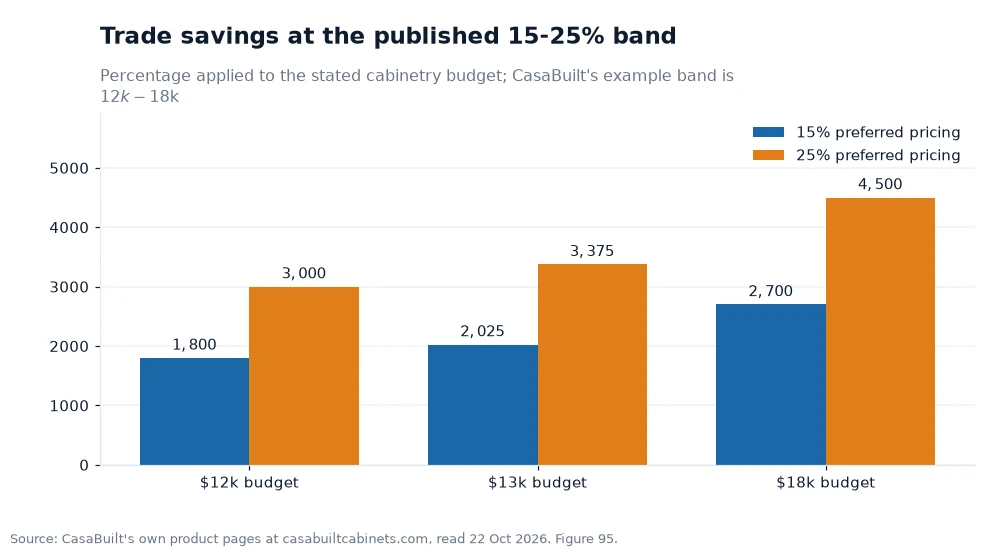
- On an $18,000 cabinetry budget the band is worth $2,700 to $4,500, which is real margin on a small job.
A contractor's brief is not a homeowner's brief
The two look similar on paper and behave differently in practice. A homeowner wants to see the kitchen and approve a look. A contractor wants a cabinet list, a price and a ship date, in that order, because the list feeds the bid and the ship date feeds the schedule. A drawing that arrives after the bid is a drawing that gets filed.
Trade briefs are also bigger. One project may include a kitchen, a laundry and a bathroom vanity run, and the design has to close each of those against a wall the plumber has already opened. That is why the trade window is published at under 72 hours rather than the 24-48 hours quoted to a single-room homeowner: the work is bigger, not slower.
The useful habit is to send one brief per project, with each room marked and each measurement tied to a wall letter. A designer who receives three rooms in one file returns three rooms in one file. Three separate emails usually return three separate drawings on three different days, and the schedule pays for it.
Win the bid on the ship date
Most bids are decided on price and then lost on schedule. A cabinet order that ships in three business days changes the arithmetic of a job, because the cabinets stop being the critical path. The standard RTA window is 3-10 business days. The trade quick-ship guarantee is three business days or less, so the worst case under quick ship is the best case under standard.
Put numbers on that. Ten business days is two working weeks; three business days is most of one. The saving between the two is seven business days, or 70% of the standard worst case, and it lands in the part of the schedule where a crew is standing around waiting for boxes.
Pre-assembled cabinets are quoted at within two weeks, which is the option for a job where the crew's time costs more than the assembly time. Alaska and Hawaii sit outside the standard RTA window, so confirm freight before quoting a start date in those states.
The cabinets free design service and the ship guarantee are separate promises. The design clock starts when the brief is complete; the ship clock starts when the order is placed. A contractor who treats them as one date will quote a start week that the order cannot meet.
What the 15-25% band does to a bid
Trade pricing is published as 15-25% below standard retail, with no strict annual minimum. That is a range rather than a rate card, so the honest way to use it is to model both ends and price the job at the end you can defend.
| Cabinetry budget | Saving, low end | Cost, low end | Saving, high end | Cost, high end |
|---|---|---|---|---|
| $12,000 | $1,800 | $10,200 | $3,000 | $9,000 |
| $13,000 | $2,025 | $10,975 | $3,375 | $9,625 |
| $18,000 | $2,700 | $15,300 | $4,500 | $13,500 |
The spread between the two ends is where the negotiation lives. On $12,000 the difference is $1,200, on $13,000 it is $1,350, and on $18,000 it is $1,800. None of that is profit until the bid is signed, but all of it is room to absorb a surprise, and a job with no room for a surprise is a job that loses money in week three.
Two details matter when you model it. The band applies to cabinetry, so it does not change the price of countertops, labor or permits. And the retail sale prices published on the style pages are a separate mechanism from the trade band, so a quote has to state which one it is using before the two are compared.
Where a fast drawing actually saves money
Three places. The first is the site visit. A design built from a measured brief does not need a second trip to confirm what the first trip recorded, and a trip is half a day plus travel. The second is the change order. A drawing that shows the filler at the end of the run lets the client approve the gap in week one rather than discovering it at installation. The third is the reorder, which is the most expensive event in any cabinet job because it carries freight twice and delays every trade behind it.
The design does not remove the need for a site check. Standard boxes assume a plane, and a wall that is out of plumb by half an inch across a run will show at the door edges whatever the drawing says. Measure the wall, then let the drawing reflect the measurement.
For a fast budget check before the design is even requested, the site's design-to-budget estimator gives a starting figure that can be compared against the trade band in the first conversation rather than the third.
Worked example
The chart gives six values across three budgets: $1,800 and $3,000 at $12,000, $2,025 and $3,375 at $13,000, and $2,700 and $4,500 at $18,000. Start with the clean pair. On $12,000, $1,800 divided by $12,000 is 0.15, exactly 15%, and $3,000 divided by $12,000 is 0.25, exactly 25%. On $18,000 the same check gives $2,700 divided by $18,000 equals 0.15 and $4,500 divided by $18,000 equals 0.25. Those two rows sit precisely on the band.
The middle row is worth reconciling rather than ignoring. $2,025 divided by $13,000 is 0.1558, and $3,375 divided by $13,000 is 0.2596, both a little above the stated rates. Divide the bars by the rates instead: $2,025 divided by 0.15 is $13,500, and $3,375 divided by 0.25 is also $13,500. The middle bar was computed on a $13,500 budget, so treat it as the $13,000 to $14,000 step rather than an exact $13,000 figure.
Now cost the job at both ends of the $18,000 budget. At the low end you pay $15,300 for the cabinetry, and at the high end $13,500. The gap is $1,800, which is 10% of the budget and just over $600 more than the $1,199.50 White Shaker starter kitchen. If the job also qualifies for quick ship, the schedule gains up to seven business days against the 10-day standard window, and seven days of a crew's time is usually worth more than the $1,800 spread.
Divide the high-end saving by the starter kitchen price and you get $4,500 divided by $1,199.50, or 3.75. The trade band on one $18,000 job is worth nearly four entry-level kitchens at retail. That is the number to keep in mind when a client asks why the trade pricing matters on a job this size.
Frequently asked questions
Does the trade design cover more than one room?
Yes. The trade service is published as free kitchen and room designs in less than 72 hours, which covers a kitchen plus adjoining rooms in a single brief. Send each room marked separately with its own wall letters and measurements so the drawings come back as one set rather than three.
How fast can a trade order ship?
The trade quick-ship guarantee is three business days or less for eligible orders. Standard RTA cabinets ship in 3-10 business days and pre-assembled cabinets are quoted at within two weeks. Alaska and Hawaii are excluded from the standard RTA window, so confirm freight before you quote a start date.
Is there a minimum order for trade pricing?
No strict annual minimum is published for the trade program, which lists 15-25% preferred pricing against standard retail. Confirm the rate that applies to a specific project when you request the quote, because the band is a range and the rate is set per account.
Send the brief before the bid
Measure the rooms, letter the walls and put every appliance width in the same file, then send it as one trade brief and hold the quote until the drawings come back. Price the job at the low end of the band and keep the high end as contingency rather than margin. Confirm the ship window against the install date before the contract is signed, and keep the cabinet list beside the drawing until the boxes are on the wall.
Figures quoted here come from the manufacturer's own website, read 22 Oct 2026[1].