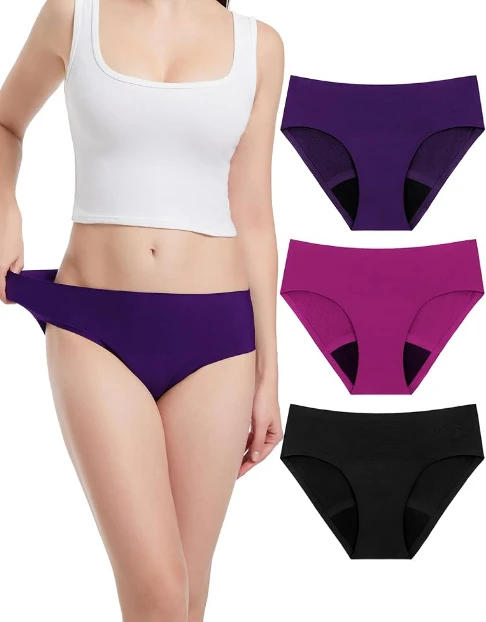
Period panties can handle everyday menstrual flow, but actual capacity varies sharply by product and by how quickly fluid arrives. A 2024 peer-reviewed study testing 21 menstrual products found that three pairs of super-absorbency period underwear held 1, 2, and 3 mL of packed red blood cells, averaging 2 mL, while several disposable products held 20–52 mL. Brand claims can be much higher, with current products commonly advertised from about 5 mL to 60 mL or more. For light or moderate flow, period underwear may work alone; for heavy or rapid bleeding, changing sooner or adding another menstrual product may be necessary.
period panties are designed with multiple fabric layers that work together rather than relying on one thick absorbent pad. A typical construction uses a moisture-wicking surface, an absorbent middle layer, and a leak-resistant outer layer. The absorbent section can extend from the center toward the front or back, with larger coverage often used for overnight styles.
The amount a pair can hold depends on its fabric blend, absorbent layer, surface area, compression, and the manufacturer's test method. In 2024, DeLoughery and colleagues reported that period underwear was the least capable category in their blood-based comparison, averaging 2 mL across three pairs, although the sample was small and each product was tested once.
That result needs context because menstrual products are not tested under one universal capacity standard. The same 2024 paper noted that only tampons had industry-regulated absorbency testing, while manufacturers of other products may use water or saline. Packed red blood cells are closer to menstrual blood than saline, but menstrual fluid also contains tissue and other secretions.
“Only tampons undergo industry-regulated testing for absorption capacity.”
The lack of one testing method makes product labels difficult to compare. A 2026 review of 39 current absorbency claims from 13 brands found that only 8 claims, or 21%, stated capacity directly in millilitres. Another 24 were expressed as tampon counts, while 7 came from conflicting or unconfirmed sources.
Tampon comparisons also create a measurement problem. Under the FDA's absorbency standard, a regular tampon corresponds to more than 6 g and up to 9 g of test fluid. A statement such as “10 tampons' worth” therefore does not identify one fixed volume unless the brand states which tampon capacity it uses.
Current product claims show the wide spread. A 2026 cross-brand review reported examples ranging from about 5 mL for light styles to 60 mL for some super-heavy products. Among products labeled “Heavy,” listed capacities ranged from roughly 20 mL to 63 mL, a difference of more than 3 times between brands using the same general label.
| Product description | Reported capacity examples |
|---|---|
| Light styles | about 5–15 mL |
| Moderate styles | about 18–36 mL |
| Heavy styles | about 20–63 mL |
| Higher overnight styles | up to about 60 mL |
These figures should be read as product claims or normalized comparisons, not as guaranteed leak-free volumes. The 2026 cross-brand review specifically noted that many values came from manufacturer claims, with some converted from tampon counts rather than measured directly in millilitres.
Flow speed also changes how absorbent underwear feels in actual use. Menstrual fluid does not always arrive slowly and evenly. The 2024 study noted that sudden heavy flow, often described clinically as flooding, and clots can make absorption more difficult. The researchers also said their slow, controlled application of packed red blood cells could not reproduce those faster episodes.
This is why a pair that works for six or eight hours on a light day may need changing much earlier on a heavy day. A clock-based rule is less useful than checking whether the gusset remains comfortable and whether moisture is approaching the edges.
Body position can affect coverage as well. Sitting, walking, bending, exercising, and lying down place the gusset differently against the body. A design with extended rear coverage may be more suitable for sleep, while a narrow everyday cut may have less material available outside the center area.
Size should also be separated from absorbency. In the 2024 study, the researchers tested the same super-absorbency underwear in small, medium, and large sizes. The recorded volumes were 3 mL, 1 mL, and 2 mL, and the difference was not statistically significant. That does not mean size never affects comfort or leakage; it shows that a larger garment does not automatically contain more absorbed blood.
Fit matters more when fluid approaches the edges of the gusset. Underwear that sits firmly against the body can keep the absorbent zone in the right position, while a loose fit may allow fluid to travel beyond the protected area. Very tight underwear can also be uncomfortable, especially after several hours.
For light flow or spotting, a lower-capacity pair may be enough because there is more space between normal use and saturation. This can be useful at the beginning or end of a period, when bleeding may be limited to small amounts rather than continuous flow.
Moderate flow calls for closer matching between the product and the wearer's usual pattern. If a person normally changes a pad every 4–8 hours on lighter days, a comparable period-underwear schedule may work as a starting point, but ACOG notes that period underwear may need to be changed more often depending on the underwear and the amount of flow.
ACOG states that period underwear can be worn for a full day, but the timing depends on the underwear and the flow.
Heavy flow requires more attention because clinical definitions use much faster product changes as a sign of unusually heavy bleeding. ACOG lists soaking through one or more pads or tampons every hour for several hours, bleeding longer than 7 days, or needing multiple pads at once among signs of heavy menstrual bleeding.
The NHS gives a similar reference point: needing to change a pad or tampon every 1–2 hours, using two period products together, bleeding through clothing or bedding, or having periods lasting more than 7 days can indicate heavy periods that should be discussed with a clinician.
For someone with heavy flow, period underwear can still be useful as backup. The 2024 blood-based study reported that people with heavy menstrual bleeding who used period underwear often used it under a pad or with an internal product, or on lighter days. The authors also noted that period underwear performed poorly in their testing when compared with several other menstrual products.
That makes backup use practical during commuting, work, exercise, or travel. If a tampon, menstrual cup, or disc reaches its normal collection point before leakage occurs, the underwear provides another absorbent layer around the exterior.
Comfort is another part of everyday performance. A high-capacity gusset may contain more absorbent material and feel thicker than a light design. Fabric density, seam placement, waistband tension, leg opening, and moisture-wicking performance can affect how wearable the product feels after 4, 6, or 10 hours.
Cleaning affects repeated use because the absorbent layers have to remain open enough to take in fluid. Washing instructions vary by manufacturer, so the garment label should control. Many brands recommend avoiding fabric softener and excessive heat because these can affect specialty fabrics, elastic, or water-resistant layers.
Drying time also matters for everyday rotation. If a pair takes one full day to wash and dry, using period underwear as the only menstrual product requires several pairs rather than one or two. Someone washing laundry every 2 days will need a different number of pairs from someone doing laundry every day.
A simple rotation can match absorbency to the day:
| Typical use | Practical style |
|---|---|
| Spotting | Light |
| Light menstrual flow | Light to moderate |
| Regular daytime flow | Moderate |
| Heavy daytime flow | Heavy |
| Sleep or longer periods without changing | Higher-capacity or overnight |
| Leak protection with another product | Light or moderate backup |
There is also a difference between advertised maximum capacity and comfortable wearing capacity. A garment may technically retain more liquid when fully saturated, but many people will change it before that point because the fabric feels damp, heavy, or less comfortable. The 2024 study also noted that laboratory compression and body movement may lower the amount absorbed during actual wear.
The research sample remains too small to establish one universal performance number. The blood-based study used 21 individual products, with only three pairs of period underwear, each tested once. That is useful for showing why liquid choice and testing method matter, but it cannot predict the performance of every brand or every body.
For everyday shopping, millilitres are easier to compare than phrases such as “X tampons' worth,” especially when the product page explains the exact basis. A capacity stated in mL, the absorbent coverage shown in product diagrams, and clear guidance for light, moderate, heavy, or overnight flow provide more useful information than a broad label alone.
When bleeding changes from a person's usual pattern, product capacity should not be the only consideration. ACOG considers bleeding lasting more than 7 days or requiring pad or tampon changes every 1–2 hours a reason to seek medical advice, and the NHS also recommends medical review when heavy periods affect normal daily life.
For everyday use, a period panty works best when its tested or stated capacity, fit, coverage, and change interval match the actual amount and speed of menstrual flow. A light pair can be comfortable for spotting, moderate designs can cover ordinary daytime bleeding, and higher-capacity styles can provide more room during heavier periods, while backup use remains practical when flow is difficult to predict.